Driif Mission OS

The Future of Autonomous Missions.

Manned and unmanned teaming across multi-domain UXVs and C-UXVs.

Explore Mission OS

The Orchestration Gap

UAV feed Operator
Radar track Operator
RF monitor Operator
USV telemetry Operator

Four feeds arriving on their own terms — a UAV feed, a radar track, an RF monitor, USV telemetry — and each one with its own operator underneath it. Four separate stacks, none of them talking to the others.

Autonomous systems are advancing. Operations remain fragmented.

UAVs, UGVs, USVs and other autonomous systems are becoming increasingly capable. Every system brings its own control architecture, data and interface. As fleets become more heterogeneous, operators face a harder problem: orchestrating heterogeneous systems around shared objectives in real time, across the edge and the command layer.

The challenge is no longer individual platform autonomy. It is orchestrated autonomy at mission scale.

The Mission Layer

Introducing Driif Mission OS

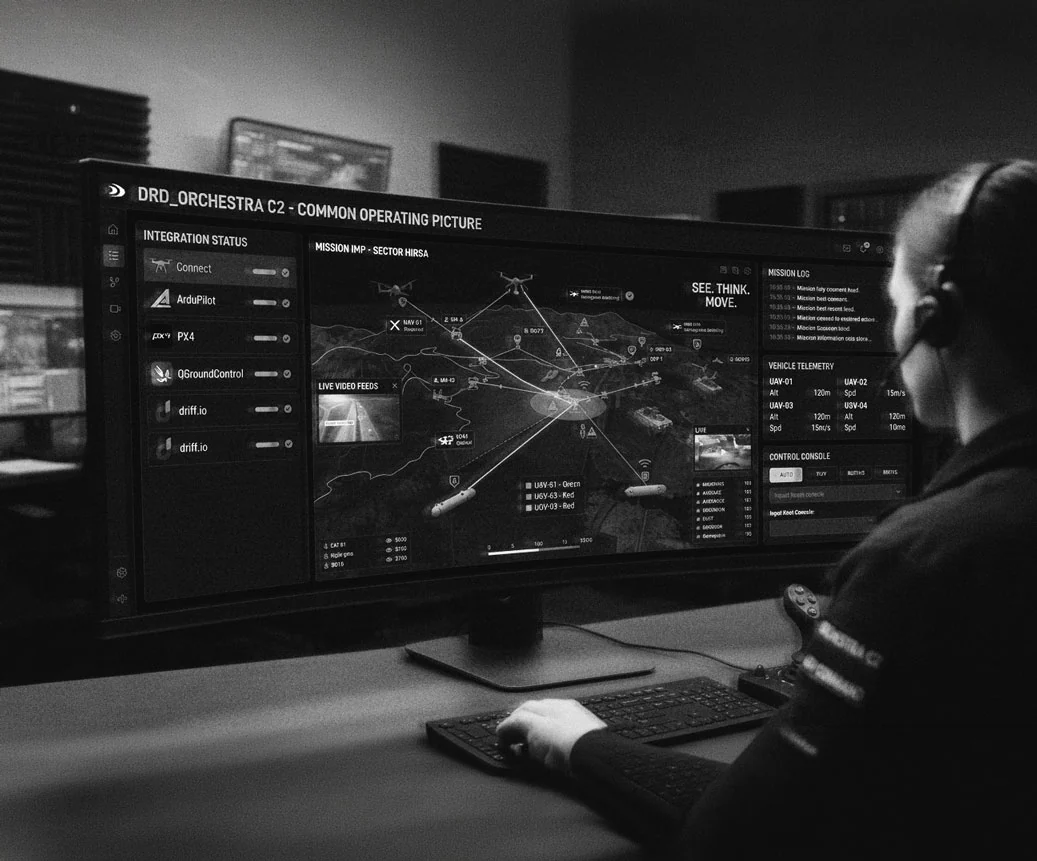
Driif Mission OS is a unified software platform that enables heterogeneous autonomous systems to operate as one coordinated force.

It brings together platform state, telemetry, sensor data and mission-level decision-making to translate operator intent into coordinated action, distributing mission logic and execution from command to edge.

Explore Mission OS
  1. 01More

    Heterogeneous Integration

    Integrate platforms, payloads and sensors across OEMs and domains without replacing existing deployed systems.

  2. 02More

    Shared Operational Picture

    Bring platform state, telemetry and sensor data into a common view of the operating environment.

  3. 03More

    Edge-Native Execution

    Execute defined mission logic and autonomous behaviours closer to the asset, including under degraded connectivity.

  4. 04More

    Human Authority

    Apply policy and command authority across the system while enabling defined actions to execute autonomously at the edge.

  5. 05More

    Sovereign Deployment

    Deploy the mission layer in the environments and configurations your operation requires.

  6. 06More

    Force Multiplier

    Coordinate existing platforms more effectively instead of solving every capability gap by adding more hardware.

Products

Purpose-built for different mission requirements.

Driif Mission OS provides the underlying architecture for autonomous operations. VIPER and NEXUS apply that architecture to distinct operational requirements.

Deployments

Mission OS, extended to the field.

Complementary systems bring Driif’s mission capabilities into field deployments, from edge-level execution on autonomous platforms to portable command and communications infrastructure.

Visual to come: SCOUT running on an autonomous platform

Edge agentSoftware

SCOUT

Edge intelligence for autonomous platforms.

Driif’s edge agent, SCOUT, extends VIPER and NEXUS capabilities onto autonomous platforms, bringing mission logic and execution closer to the point of action.

Visual to come: approved photograph of the C4 node

Field command & controlHardware

Man-Portable C4 Node

Command capability in a deployable form.

A compact field unit integrating communications, a tablet, antennas and power. Designed to enable one operator to manage 100+ unmanned and counter-unmanned systems for 3–6 hours.

100+Systems, one operator

3–6 hOperating time

Applications

For autonomous missions across defence and industry.

Driif applies the same mission architecture to distinct operational environments, integrating the platforms, sensors, and command systems already deployed.

Integrate your systems.
Orchestrate your missions.

Request a demo

Glossary

The language of autonomous operations.

UAS, IFF, C-UAS, swarming: the vocabulary around multi-domain autonomy moves fast. Our glossary defines the terms that matter in plain language, with a short quiz to test what stuck.

Explore the glossary